
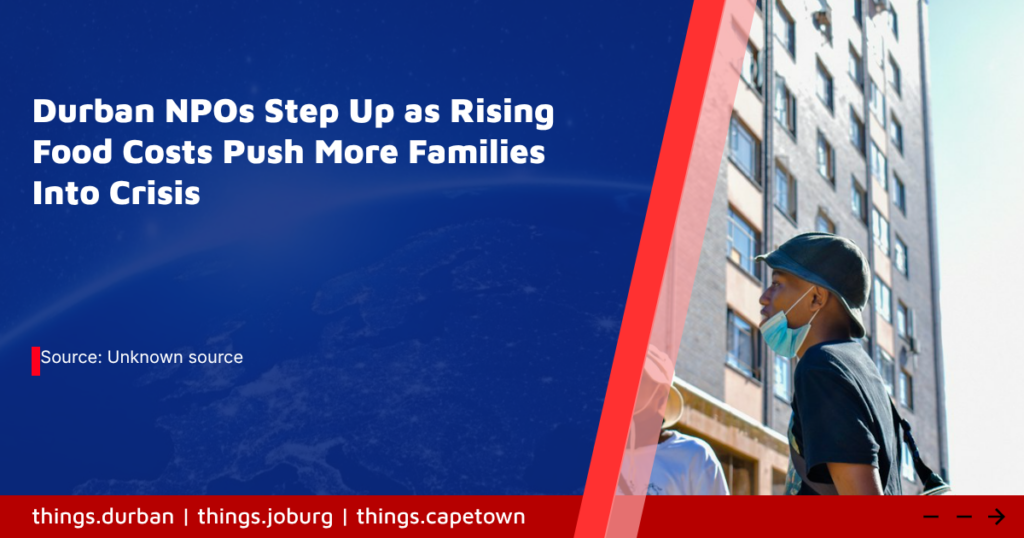
Durban NPOs Step Up as Rising Food Costs Push More Families Into Crisis
Across Durban, community organisations are becoming a lifeline for thousands of residents who can no longer keep up with the rising cost of living. From weekly school lunches to bread hand-outs and bulk food hamper drives, non-profits are absorbing a growing demand for help as household budgets buckle under inflation, unemployment and stagnant wages.
While these groups are managing to keep feeding programmes running, their leaders are united in a warning: emergency food relief is a short-term patch, not a solution. Without sustainable funding, skills development and real job opportunities, the underlying causes of hunger in the city will persist.
Aurora Hands of Hope
Shubnam Bhogal, founder of Aurora Hands of Hope, says food insecurity in areas such as Welbedacht East, Mount Moriah, Phoenix, Verulam, Tongaat and Merewent is both widespread and visible. The organisation’s weekly feeding programmes currently reach more than 1,200 people, supported by bread and grocery distributions and community soup kitchens.
Bhogal says the people seeking help are not only unemployed or elderly residents, but increasingly working families whose income simply doesn’t stretch far enough once rent, electricity and transport costs are covered.
“Many people are not approaching us because of a once-off crisis. They are experiencing ongoing financial pressure and return for assistance because their circumstances have not changed,” she says.
She says sustainability, not willingness, is the organisation’s biggest constraint — feeding programmes rely on consistent donations for food, transport, gas and packaging, none of which can be guaranteed. Aurora Hands of Hope is currently preparing its annual Diwali and Christmas drives to support vulnerable families with food and essential items.
Seva Hands’ School Lunch Programme
For Seva Hands, the flagship initiative is a school lunch drive feeding 810 pupils a week across communities including Riet River, Motala Heights, Isipingo, Phoenix, Chatsworth, Merebank, Gillitts, Clare Estate, Reservoir Hills and Newlands East.
Treasurer Aneshnee Yegambram says participating schools have reported full attendance on days when lunches are served, suggesting the programme does more than meet a nutritional need — it may be keeping children in the classroom.
“No child should have to learn on an empty stomach,” says Yegambram, adding that demand for support has climbed over the past year as living costs and unemployment rise. The organisation, which also runs an annual food hamper drive, says it has had to prioritise its core lunch programme even as other urgent needs emerge. Its next hamper initiative is scheduled for November 1.
Food for Love Africa’s Mass-Feeding Model
Food for Love Africa runs 11 kitchens across South Africa, including sites in Phoenix, Verulam and Chatsworth, producing meals distributed daily to schools and communities by partner organisations. Spokesperson Lisa Sukdev says even middle-income households are now occasionally asking for food support as wages fail to keep pace with inflation.
As of the end of August, the organisation had served 50 million plates of food over six years. Sukdev says the impact of rising costs is particularly harsh on schoolchildren, who often receive poorly balanced meals despite a national school nutrition programme.
“Despite being a volunteer-run and donor-based organisation, we are limited in what we can do. We need funding and donations of fresh vegetables, gas, oil, rice, and grains,” she says.
To help close the gap, the organisation hosts its biggest annual fundraiser, The Rice Drive, with a convoy departing from The Saxony in Springfield Park and Sibaya Casino. The event includes supercars, live entertainment and a free lunch, while giving visitors a look at how the kitchens operate.
How to Get Involved
- Aurora Hands of Hope – 073 598 5810
- Seva Hands – 060 467 7216
- Food for Love Africa – 083 937 4171
With Durban’s cost of living continuing to climb, these organisations say ongoing community support — not just once-off donations — will be key to keeping their programmes running into 2026.
Source: Community organisations feed thousands as Durban families face rising food costs — IOL